

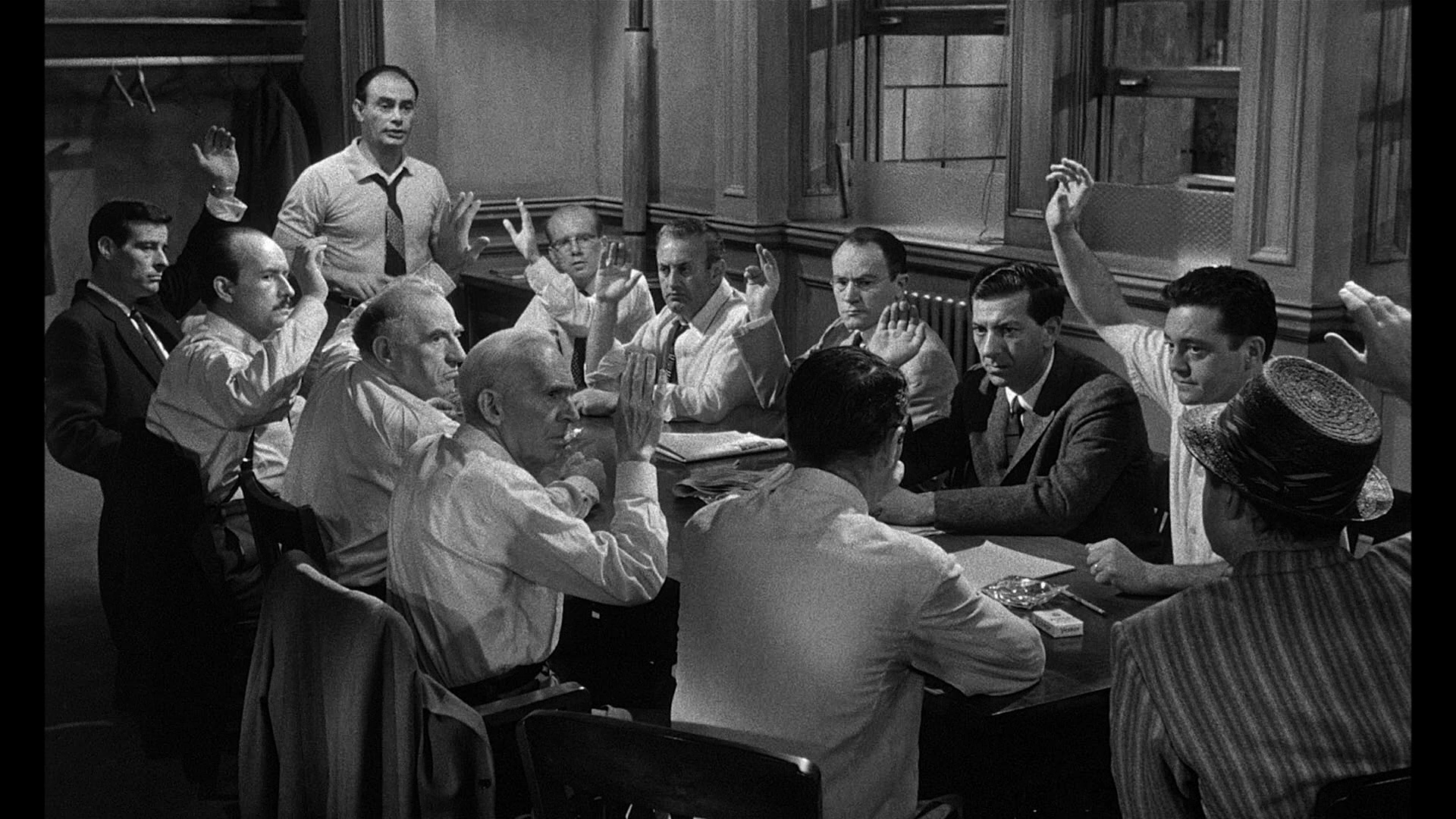
Twelve Angry Men started as a teleplay written and released in 1954 by writer Reginald Rose as a part of the anthology television series Studio One. It has been adapted as a full film twice, with the first film releasing in 1957 and the second film releasing in 1997.
General Premise
The general story of 12 Angry Men focuses on a jury of twelve men working on a case of an 18-year-old boy from the city slums who allegedly stabbed his father to death. Nearly the entirety of the story takes place in the jury deliberation room, as the twelve jurors debate the case and the potential innocence of the boy. The initial vote within the room comes up 11 voting “guilty”, and the lone Juror #8 voting “not guilty”, thus sparking the entire debate across the film. It touches on themes of poverty, prejudice, racism, and class.
12 Angry Men (1957)
The original film adaptation of 12 Angry Men, directed by Sidney Lumet, starred actors Martin Balsam as Juror #1, who served as the foreman of the group, John Fiedler as Juror #2, a quieter man who works as a bank teller, Lee J. Cobb as Juror #3, a hot-tempered man who is the most supportive of the verdict being “guilty”, and E.G. Marshall as Juror #4, a stockbroker concerned only with the facts. Jack Klugman plays Juror #5, a man who grew up in similarly violent slums to the boy on trial, Edward Binns plays Juror #6, a man sympathetic to the elderly, Jack Warden plays Juror #7, an impatient man more concerned with missing the Yankees game than the trial, and Henry Fonda plays Juror #8, initially the only one to vote “not guilty”. Joseph Sweeney plays Juror #9, an observant elderly man who paid close attention to the body language of the witnesses, Ed Begley plays Juror #10, a loud man who pushes his xenophobic views, George Voskovec plays Juror #11, a polite European watchmaker, and Robert Webber plays Juror #12, an easily distracted advertising executive.
12 Angry Men (1997)
The 1997 adaptation of 12 Angry Men, directed by William Friedkin, was very similar to the original film adaptation. The film stars actors Courtney B. Vance as Juror #1, who served as the foreman of the group, Ossie Davis as Juror #2, a quieter man who works as a bank teller, George C. Scott as Juror #3, a hot-tempered man who is the most supportive of the verdict being “guilty”, and Armin Mueller-Stahl as Juror #4, a stockbroker concerned only with the facts. Dorian Harewood plays Juror #5, a man who grew up in similarly violent slums to the boy on trial, James Gandolfini of The Sopranos fame plays Juror #6, a man sympathetic to the elderly, Tony Danza plays Juror #7, an impatient man more concerned with missing the Yankees game than the trial, and Jack Lemmon plays Juror #8, initially the only one to vote “not guilty”. Hume Cronyn plays Juror #9, an observant elderly man who paid close attention to the body language of the witnesses, Mykelti Williamson plays Juror #10, a loud man who pushes his xenophobic views, Edward James Olmos plays Juror #11, a polite European watchmaker, and William Peterson plays Juror #12, an easily distracted advertising executive.
Comparison
Since both films adapted Rose’s original teleplay, they are almost identical in story, sharing exact dialogue and story beats. They do differ with appropriate pop cultural references for the time periods they were released, but the characters all largely share their same core traits across both adaptations. They only differ in length by roughly 20 minutes, with the 1997 film being longer.
The clearest difference when immediately comparing the two films are the casts. The original 1957 film has the jury consist of 12 white men, causing the discussion around the trial to initially be clear cut to most of the jurors. However, as the discussion around the boy’s innocence begins, faults begin to make themselves clear – differences in age, education, nationality, morals, and socioeconomic status cause more and more jurors to waver on their initial “guilty” verdict. These discussions are made even more complicated by the 1997 remake, where discussions of race are brought into the picture as 4 jurors are African American and Juror #10 goes on a bigoted rant against Hispanic people, as the boy on trial was Hispanic. Juror #10 pleads to his fellow African American Jurors while going on his racist tirade, only to be staunchly rejected and told to stop talking. While Juror #10 had a similar xenophobic rant in the 1957 film, it was slightly less overt in its specificity. The culmination of the rant in both films ends in Juror #10 being looked at with disgrace and told off to be quiet, as he sulks to the corner and finally changes his vote from “guilty” to “not guilty”. Another difference in casting are the ages of the characters. In the 1957 original, Juror #9 was by far the eldest of the group, with the rest of the jury being younger than him by decades. However, the 1997 film changes this by aging up various other jurors closer to the age of Juror #9, including Juror #8 and Juror #3.
The other most striking difference between the films are the visuals. Most obvious is the color, as the 1957 film was released in black-and-white while the 1997 film was released in color. There is also a fair difference in the cinematography of the two films. The camera work of the 1957 film feels more fluid, providing zoom-ins, closeups, wide group shops, and even a tracking one-shot to open up the film. By contrast, the made-for-television 1997 film feels far more static, lacking some of the fluidity and intensity brought by the cinematography of its predecessor.
From an acting perspective, both casts deliver strong performances, each actor filling their role suitably. Courtney B. Vance as Juror #1 in the 1997 film stood out as a powerful calming presence over the rest of the jury, while Tony Danza as Juror #7 serves as a perfect wise-cracking, impatient baseball fan. Henry Fonda as Juror #8 in the 1957 adaptation presents the character as an at first unsure yet ultimately convincing jury member. Comparatively, Jack Lemmon’s role as Juror #8 in the 1997 version comes across as a more grandfatherly role as opposed to Fonda’s fatherly role. He would fulfill a similarly impactful life changing role in his final performance in 1999 as Morrie Schwartz in Tuesdays with Morrie.
Conclusion
While the 1997 television film adaptation presents strong performances and a close word-to-word script to the original, the 1957 film presents stellar performances, smooth and diverse camera work, and powerful characters that stand distinctly from each other. However, the 1997 film still stands on its own for its enhancement of themes against prejudice and racism through its more diverse cast.
