
 Luciana Vigil September 7th, 2025 - 10:25 PM
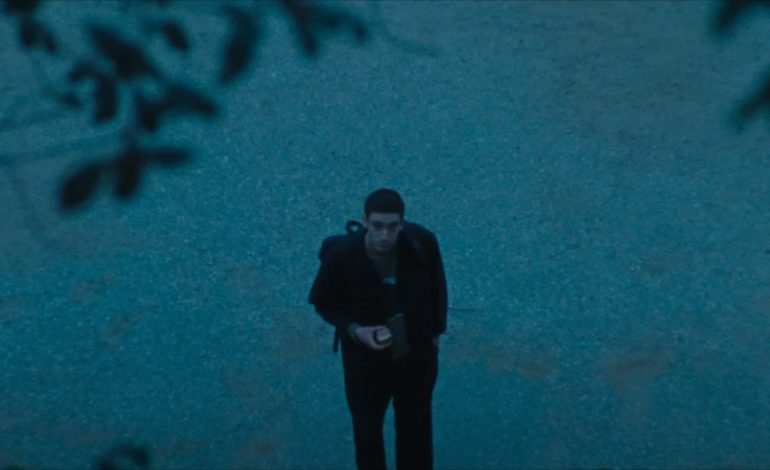
From Misery (1990), to The Talented Mr. Ripley (1999), to Zodiac (2007), audiences have consistently been drawn to the theme of obsession. It could be said that lurking is somewhat inherent to all movie-viewing experiences, but that movies that follow an obsessive protagonist — that allow us to observe the observer, to become complicit in seeing what should not be seen — intensify this feature. Alex Russell’s directing debut, Lurker, offers his own take on obsession. His protagonist isn’t simply seeking belonging or validation — the goal here is total control. It is an anxiously attached person’s ultimate wet dream: to gain full dominance over the ever-elusive object of their fixation, to become undeniably bound together. With a memorable opening scene set to Nile Rodgers’ My Love Song for You, this is a fun ride that pulls you in from the start.
Matthew, flawlessly portrayed by Théodore Pellerin, is a young retail clerk who manages to catch the attention of up-and-coming pop star Oliver, charmingly interpreted by Archie Madekwe. He is advised to make himself necessary if he wishes to stick around. But in the superfluous, brain-rotting, viral “pasta-gate” reality of our time, skill doesn’t make one essential. Likeability does. Matthew sucks up to Oliver enough to enter his clique. He can’t conceal his intensity for long, however, so Oliver cuts him off — or so he thinks. Matthew blackmails his way back into Oliver’s life, and what seems like a life sentence of misery turns out to be a pretty decent deal for both. The fact that such a premise didn’t take itself too seriously was a relief, which resulted in some genuinely funny moments. A packed theater laughed out loud when Oliver, dressed like a walking Golf Wang ad, identifies Matthew as a “real person”. The psychological thriller element, essential to this type of story, was unfortunately unsatisfying. Matthew’s actions cause awkwardness, maybe some discomfort, but never fully make our skin crawl. He gets close, but by always offering a way out, there’s no real sense of danger to Oliver’s career or life.

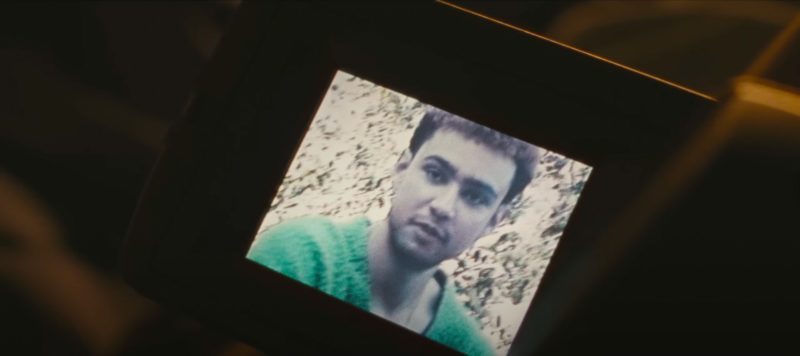
Visually, Lurker makes deliberate choices. Mainly shot on 16mm film and frequently employing hand-held close-ups, the look is an intimate and naturalistic one. When it switches from analog to a camcorder, though, the intended contrast doesn’t quite land. In a time when cell phones offer some of the highest image quality, the nostalgia evoked through the lens of a low-grade digital camera also becomes intimate and natural. The effect ends up being that of watching a documentary within a documentary, which isn’t necessarily a bad thing, and could even be interpreted as meta-commentary on the filmmakers being lurkers themselves. On a different note, while some veteran directors have expressed disdain for the display of phone screens in movies, Russell and DP Patrick Scola make a strong case for them, proving their understanding of the small screen’s cinematic potential when used to reveal interiority. That smiley face at the end of one of Matthew’s texts was easily one of the tensest and funniest moments in the film.
The story is narratively strong in its simplicity. The linear structure and lack of elaborate subplots highlight the idea that obsession demands focus. Russell, writer of arguably The Bear’s best episode, “Forks”, is restrained in his storytelling, dives in quickly, and doesn’t feel the need to spell it out for us. At times, though, simplicity turns into over-simplicity, as Matthew gains access to Oliver too easily. As characters, Matthew and Oliver hardly go beyond the “obsessive fanboy” and “young pop star” tropes. In contrast to a character like Tom Ripley, whose fixation is rooted in self-neglect and the desire to escape his own skin, Matthew’s pursuit lacks a clear origin or end goal. And while it makes sense that someone like Oliver would become famous in today’s world, we don’t learn enough about him to fully put ourselves in Matthew’s shoes.
An exciting turn shifts the power dynamic as Matthew gains the upper hand. The scene at the recording booth is masterful, as Oliver begs Matthew to stop blackmailing him and return to how things were. It becomes clear that when Matthew told Oliver he was going to become the biggest star in the world, he wasn’t just saying it to stick around. Matthew doesn’t just want to be there; he wants to take Oliver to another level. In his own sick and twisted way, Matthew has a dream and a vision for Oliver, and we almost respect him for it. This is where the film could have gone deeper. Oliver eventually starts to understand Matthew’s vision, but the inevitable co-dependency born from that conversation isn’t explored further. On the contrary, by the end of the film, they emotionally seem to be at a place where that climactic scene didn’t happen at all.

Rating: 3.5/5
“What’s the difference between love and obsession?” asks Oliver as he shoots the music video for his new single. Lurker seems to humorously respond, “If it’s getting you both where you want to go, does it really matter?” That provocation, along with Russell’s confident eye and tonal consistency, makes this independent film an achievement worth our time, even if it leaves us craving a bit more danger beneath the laughter.
