
 Mikaela Lewis December 22nd, 2025 - 9:00 AM

Set in 1916, The Choral is not your typical World War I movie. Rather than focusing on the frontlines and bloodshed, writer Alan Bennett brings us to the English homefront to experience the Great War through the lens of a choir. Although a touching story, this film fell flat, succumbing to the familiar drawbacks of period pieces.
Employing Dr. Guthrie (Ralph Fiennes) to revamp the choir was not a popular decision among the members. As a matter of fact, his decisions and mere presence were not initially well-received. Criticism was especially rampant given his history of living and working in Germany. In addition, there were more subtle suggestions that he may be in a homosexual relationship with his pianist.
Behind a new and controversial conductor, the choir reimagines Edward Elgar’s “Dream of Gerontius” into an allegory for sending young men to war. This message, however, was not touched on until the final third of the movie. The first hour and change played out as a monotonous jumble of funerals for soldiers and choir auditions under the new conductor. Some of the teenagers in the choir engage in love affairs, but at such a surface level, it is difficult to feel invested in any of the characters’ lives.
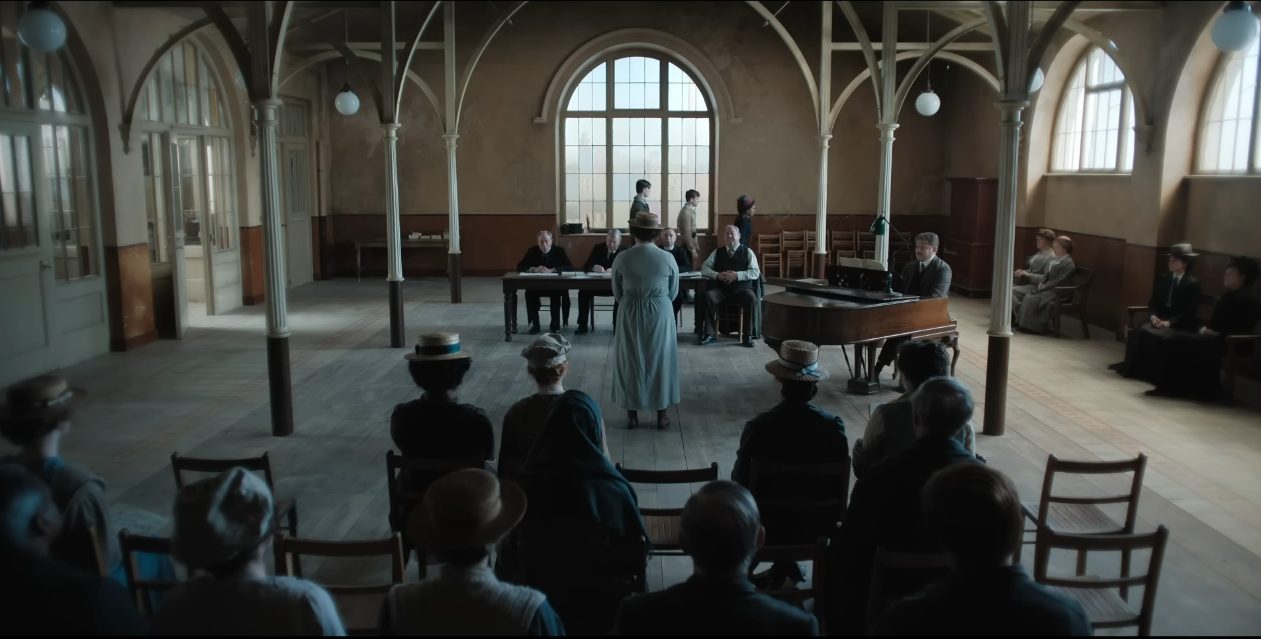
To bring Dr. Guthrie’s idea to the stage, the choir had to scrape together what men were left in Yorkshire from any pocket of town, no matter their circumstances. Thus, the group is joined by wounded soldiers, a baker, and a man whose only experience in singing came in a pub. One standout line delivered by the conductor defends the ragtag group: “the choral shouldn’t mirror the order of society; it should transcend it.”
Standard of a period piece, plenty of scenes followed the older men of the committee speaking in circles about nothing substantial for several minutes at a time. Director Nicholas Hytner and cinematographer Mike Eley made a few unconventional decisions that felt off-putting. For instance, at one point, Dr. Guthrie stares straight into the camera while addressing the committee, distracting the viewer from the scene. Another scene had the camera grow more and more obstructed until it faded to black, but was prolonged and, again, distracting.
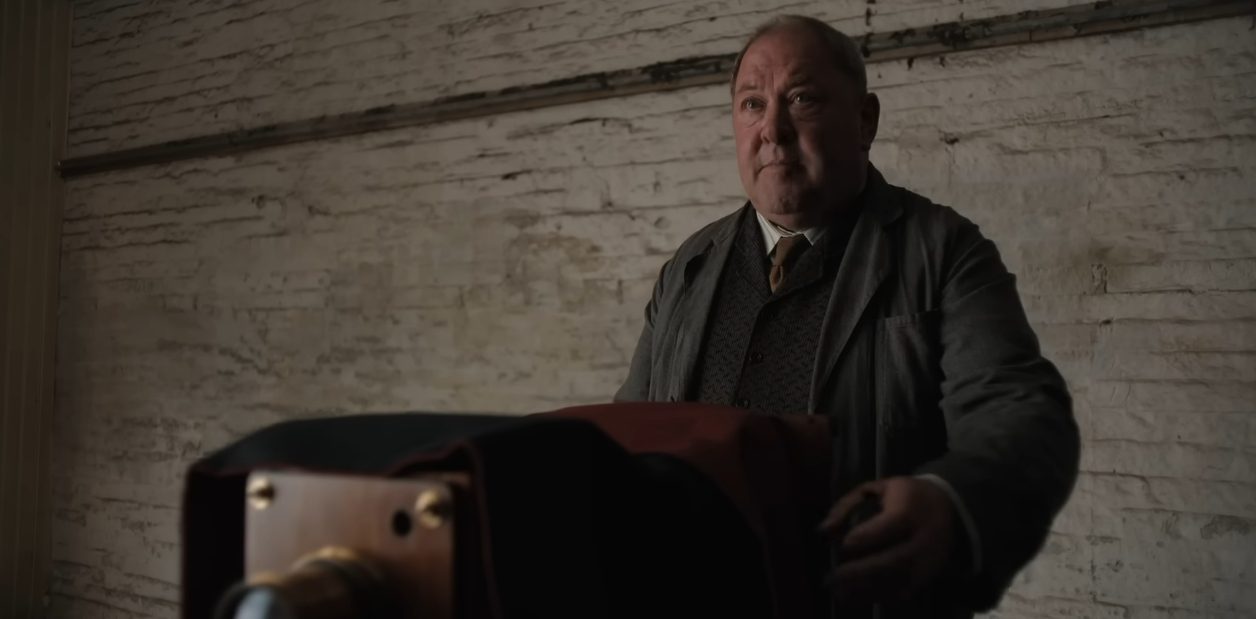
Two 17-year-old members of the choral — Ellis (Taylor Uttley) and Lofty (Oliver Briscombe) — received their command to report to the war mere days following the choral’s scheduled performance. On the eve of their departure, Ellis visited a sex worker in town to lose his virginity, but overall, for a run time of nearly two hours, the exploration of the boys’ naïvity and innocence was shallow at best.
The actual performance of “Dream of Gerontius” was enjoyable, as Dr. Guthrie decided to rework the piece into more of a musical. Not only was the singing from the leads Mary (Amara Okereke) and Clyde (Jacob Dudman), excellent, but also the cinematography was at its strongest during this tidbit.
As the movie concluded, members of the choir watched as the train departed from town carrying another crop of soldiers to the Western Front. There was potential for this moment to be far more emotional than it ultimately was, but audience members had little reason to feel attached to these characters who got little screen time.
2.5/5 Stars.
Listed as a historical comedy drama, The Choral was stretched over an uninspiring 113 minutes. While there were a number of redeeming qualities — the setting choice and costume design were standouts for this film — The Choral just played out of tune.
