
 Austin Waybright January 13th, 2026 - 6:48 PM
One day… Possibly 28 years from today, a young, ambitious lover of film will gaze upon a shelf of various DVDs, Blu-Rays, and whatever other thing comes out that inevitably replaces Blu-ray of the films of the 2020’s. Before they begin their exciting journey into discovering the great works of this decade, they will look up and notice a film called 28 Years Later, and with such a provocative title, they will immediately attempt to pull it from the shelf. However, just as their fingers begin to brush across the top of the case, out of their peripheral vision, they notice something similar, but somehow even more provocative, 28 Years Later: THE BONE TEMPLE.
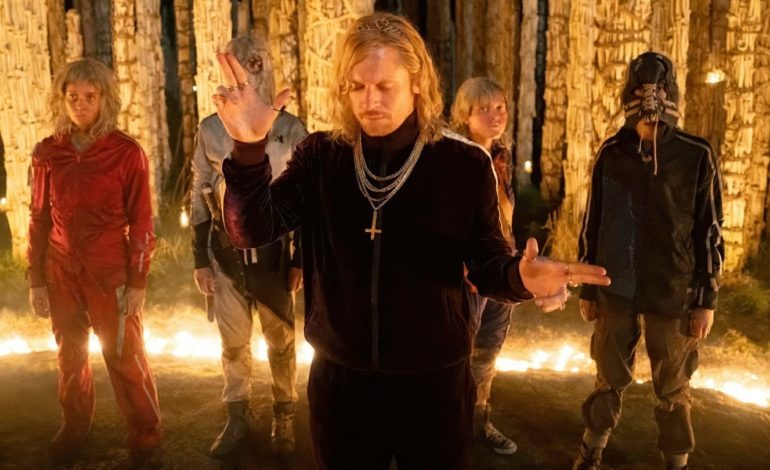
I bring up this hypothetical because I truly believe 28 Years Later: The Bone Temple, the latest installment of the “28 X Later” uhhh franchise/saga/universe, whatever, directed by Nia DaCosta, is an insane name for a film, let alone the 4th film. Starring Ralph Fiennes, Jack O’Connell, Chi Lewis-Parry, Alfie Williams, Erin Kellyman, and various other actors all playing characters named Jimmy, this sequel to 2025’s 28 Years Later acts as a second act in what is believed to be a new trilogy being written and developed by original creators Danny Boyle and Alex Garland. The film follows two parallel stories that, you guessed it, eventually collide with each other. Spike (Alfie Williams) is forced into joining Jimmy Crystal’s (Jack O’Connell) murderous cohort of Jimmy’s (Emma Laird, Robert Rhodes, Erin Kellyman, Maura Bird, Sam Locke, Ghazi Al Ruffai) as they travel post-apocalyptic England to provide “charity” for what few survivors are left on the infected island. Meanwhile, as Dr. Ian Kelson (Ralph Fiennes) continues his work of building an elaborate memorial to the dead in the form of a literal BONE TEMPLE, he develops a relationship with one of the Alpha’s, an infected of immense size and strength named Samson (Chi Lewis-Parry), and attempts to understand how and why this is possible.

Fans of the previous films will feel right at home as they dive back into the infected wasteland. The 28 X Later films have always been about highlighting how dangerous people can be in terrible times, whether they be rage-fueled infected monsters or murderous devil-worshiping youngsters, and this film is no exception. DeCosta and company focus on showing two vastly different ways of “rebuilding” society with these two parallel storylines, where one side uses strength and violence (much like the infected hint, hint), and the other uses empathy, knowledge, and kindness to help bring people up out of the rage and evil of the world. The execution of this is fascinating, as much of the first half of the film is dedicated to seeing both of these approaches in action, with the Jimmys wreaking havoc while Dr. Kelson attempts to teach an infected how to dance. The result is a wild ride of a film where we jump between the two extremes until they inevitably collide into a wonderful climax that I wish not to spoil.
The lead performances in the film are next level, starting with Jack O’Connell at his most sinister and deranged as Sir Jimmy Crystal, the son of Old Nick, AKA The Dark Lord, AKA The Beast, AKA The Devil. O’Connell continues his impressive villain run, following up his previous performance as Remmick in Sinners, showcasing his impressive ability to bounce between being magnetically charismatic and terrifyingly malicious. Much like his performance as Remmick, O’Connell makes his characters feel like the most dangerous kind of villains, callous figureheads who illustrate their cause as some sort of noble act of “charity” when they are just as, if not more, violent than the current, existing evil. The power of his charisma can be seen in how his followers, an extremely dangerous and violent group of teenagers, he calls “his fingers”. They blindly believe his gospel and will do whatever he commands, as he casually asks them to skin their victims. This swagger persists beyond violence, as Sir Jimmy Cystal is quite the wordsmith, who loves to speak in analogies, references, and jokes in such a casual, lighthearted manner that it’s borderline charming.
On the other side of the coin is Ralph Fiennes as Dr. Ian Kelson, an isolated doctor who lives a quiet life listening to Britpop vinyl records while constructing a massive mausoleum out of the bones. Fiennes imbues Kelson with the energy of a kind, old professor, with his main weapon of choice being non-lethal darts laced with morphine to subdue threats so he can escape. This is what leads him to discover Samson, whom he subdues with said darts and quickly develops a friendship with. These scenes were wonderful as Fiennes attempts to bring back the lost humanity in Samson by doing drugs (mostly morphine), listening to music, and dancing. While Fiennes is the clear standout in these scenes, Chi Lewis-Parry deserves his flowers for his role as a violent monster who slowly regains his sanity. Lewis-Parry’s performance is a quiet, compelling tale of rediscovery, even when the actor is literally a 6’9 goliath who is naked for 80% of the film and can effortlessly decapitate anything in his path. The friendship between these two characters is genuinely sweet and in stark contrast to the horrifying acts being committed in the other plot line. Fiennes does have a huge moment near the end of the film that I won’t spoil, but features pyrotechnics, Iron Maiden, and a Ralph Fiennes dance number that is a MUST-SEE scene. No joke, my audience broke out in applause after. It’s a magical, insane moment in the film that I will never forget, and it is a testament to the sheer talent of Fiennes.
The cinematography in 28 Years Later: The Bone Temple is impressive, featuring beautifully framed shots and compositions that invoke the decline of the human world, but also the beauty that can be found among the chaos. Most of the film revolves around the titular Bone Temple and the forest that surrounds it, with its massive pillars and central monolith comprised of hundreds of human skulls. The production design in general by Carson McColl and Garth Pugh is top-notch, and combined with Sean Bobbitt’s cinematography, creates this beautifully chaotic setting with such evocative imagery. As I watched the film, I was reminded of Mad Max 2: The Road Warrior, an equally bonkers and violent movie, and how that film takes the world of the previous film and dials it up to 11, with no way to go back. Truly, the best movie to compare The Bone Temple to might be The Road Warrior, in that they both elevate an already established apocalypse setting through characters, themes, locations, and imagery. Hell, I’d even say that 28 Years Later: The Bone Temple would fit right in with late-night reruns of The Road Warrior on HBO. One last note the production, the soundtrack rocks. Go blind if you can get ready to pump your fist to some of the needle drops; they rock.
28 Years Later: The Bone Temple may not be the best film of 2026, but as of the time of writing, I have no choice but to say the bar has been set pretty high. If you’re fan of post-apocalypse nightmares about the human condition mixed with some great performances, excellent need drops, and stellar visuals, then grab some friends and find your way to the Bone Temple before it’s out of theatres.
4/5 Stars
NOW APOLOGIZE FOR BEING MEAN TO DECOSTA FOR DIRECTING THE MARVELS. YOU KNOW WHO YOU ARE.
Set just after the events of the previous film, 28 Years Later: The Bone Temple follows Spike (Alfie Williams) who is forced into joining Jimmy Crystal’s (Jack O’Connell) murderous cohort of Jimmy’s (Emma Laird, Robert Rhodes, Erin Kellyman, Maura Bird, Sam Locke, Ghazi Al Ruffai) as they travel post-apocalyptic England to provide “charity” for what few survivors are left on the infected island. Meanwhile, as Dr. Ian Kelson (Ralph Fiennes) continues his work of building an elaborate memorial to the dead in the form of a literal BONE TEMPLE, he develops a relationship with one of the infected Alpha’s, an infected of immense size and strength named Samson (Chi Lewis-Parry), and attempts to understand how and why this is possible. The film is directed by Nia DeCosta, written by Alex Garland, and is produced by Columbia Pictures, DNA Films, and Decible Films. Go see it in theatres on January 16th.
