
 Cyrus Basharkhah June 1st, 2025 - 5:28 PM
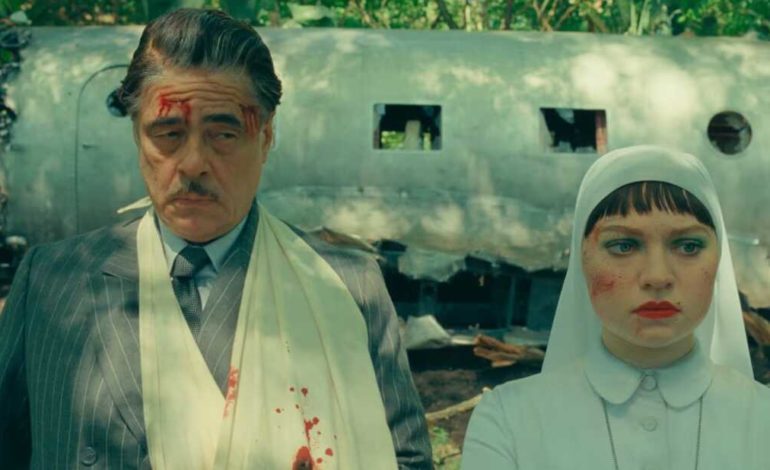
Among the star-studded ensemble of The Phoenician Scheme, its most important dynamic lies with the father and daughter relationship embodied by Academy Award winner Benicio del Toro as the pulpish entrepreneur Zsa-zsa Korda and newcomer Mia Threapleton as his daughter-turned-nun Liesel. The daughter of movie star and consummate actress Kate Winslet, Threapleton’s previous film work had been limited to minor roles in British productions and a sole starring turn in obscure Italian thriller Shadows. Threapleton also found success on television as part of the dramatic cast of Buccaneers, a period culture clash drama set to premiere its second season this June, in a serendipitous synchronicity with The Phoenician Scheme.
As the latest feature-length venture by critically acclaimed comedy director Wes Anderson, The Phoenician Scheme is set to offer a significantly larger springboard for Threapleton’s work to theatergoing audiences. Threapleton discussed the pressures of auditioning for the famed director, as well as the feelings of relief that washed over her when she realized that she did not have to find Anderson “scary” as an actress in the auditioning process.
Wes Anderson sets often communicate a sense of gregariousness between filmmaker, cast, and crew. His filmography since his auspicious origins in 1996 with Bottle Rocket possesses a strong continuity of actors returning from project to project, most frequently with Bill Murray, Adrien Brody, Owen Wilson, and Jason Schwartzman as the sturdiest members of the Wes Anderson troupe. Other stars such as Tom Hanks, Scarlett Johansson, and Bryan Cranston have more recently established themselves as Anderson regulars, with The Phoenician Scheme marking Hanks’s second collaboration and the latters’ third in under a decade. The dedication these actors have for their director extends to their willingness to work for scale, at rates far below what they could easily muster from another production, but which allows for Anderson to complete his projects within a small financial ecosystem. Johansson completed work on Anderson’s Asteroid City for $4,131 a week, an experience she painted as “happily.” Threapleton verifies this phenomenon with her observation that Anderson’s workplace is marked by “a lot of love” and that actors “keep coming back because they love him, and he loves them.” With Phoenician Scheme as their first work together, one waits to see if Threapleton persists as a long-time contributor to the handcrafted worlds of Wes Anderson.
